Open reduction and internal fixation (ORIF) is a type of treatment to fix a broken bone. It puts the pieces of a broken bone back together so they can heal. Open reduction means the bones are put back in place during a surgery through an open cut (incision). Internal fixation means that special hardware is used to hold the bone pieces together. This helps the bone heal correctly. The procedure is done by an orthopedic surgeon. This is a doctor with special training in treating bone, joint, and muscle problems.
How does a tibia/fibula fracture happen?
The tibia and fibula are the two bones of your lower leg. The tibia is your shinbone. It’s the larger bone. The fibula is the smaller bone that sits next to the tibia. The top of the tibia forms part of the knee joint. The bottom of both the tibia and the fibula forms the upper part of the ankle joint.
An injury may break (fracture) your tibia, your fibula, or both into two or more pieces. This might happen near your knee, in the middle of your shin, or near your ankle. A fracture near your ankle may be called a broken ankle. You may have a fracture in 1 or both bones. A bone may break but the pieces are still lined up correctly. Or the pieces may not line up correctly. This is called a displaced fracture.
A broken tibia or fibula can happen from a car or bicycle accident, contact sports, a fall, or activities with movements that you do over and over again. Older adults with low bone density (osteoporosis) are more at risk for breaks in these bones.
Why is ORIF done?
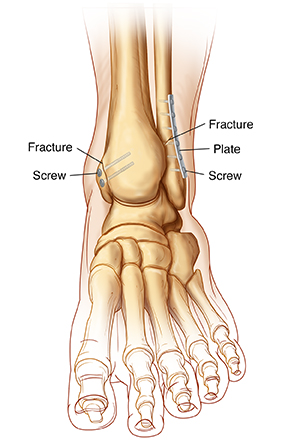
During an open reduction, the bone pieces are put back in their correct alignment. The bones are then connected back in place with hardware. This is called internal fixation. The hardware may include screws, plates, rods, wires, or nails. This helps the bone heal correctly.
You may need ORIF if:
-
You have a displaced fracture.
-
Part of your tibia or fibula broke through the skin.
-
Your tibia or fibula broke into several pieces.
-
Your fracture involves your knee or ankle joint.
-
You had other treatment, but your fracture did not heal well.
How is a tibia/fibula fracture ORIF done?
The surgery is done by an orthopedic surgeon. The surgeon will make a cut (incision) through the skin and muscle of your leg. They will put the pieces of your tibia or fibula, or both, back into place (reduction). The pieces of the broken bones will be secured to each other (fixation). Your surgeon may use screws, metal plates, wires, pins, or a metal rod placed inside the bone.
What are the risks of tibia/fibula fracture ORIF?
All surgery has risks. The risks of tibia/fibula fracture ORIF include:
-
Infection.
-
Bleeding.
-
Nerve damage.
-
Bone healing out of alignment.
-
Blood clots.
-
Fat embolism.
-
Broken screws or plates.
-
Loss of movement.
-
Damage to the bones from the hardware.
-
Skin irritation from the hardware.
-
Misaligned bones.
-
Problems from anesthesia.
-
A need for more surgery.
Your risks vary based on your age and general health. For example, if you are a smoker or if you have low bone density, you may have a higher risk for certain problems. People with diabetes may also have a higher risk for problems. Talk with your surgeon about which risks apply most to you.


Related Articles
Shoulder Joint Surgery: Bankart Repair
A Bankart lesion is a shoulder injury. It happens when there is a tear in the labrum. This is the fibrous cartilage that helps hold the shoulder joint in place. Surgery can repair this injury.
Understanding Ankle Fusion
Ankle fusion is a type of surgery used to join two or more bones of your ankle. The surgery is done to treat arthritis in the ankle.
Foot Surgery: Bone Spurs
A bone spur (an extra bone growth) can make walking and wearing shoes painful. There are several nonsurgical treatments for bone spurs. But if these aren't effective, surgery can be considered.
Hip Fracture Surgery: Preparation
After a hip fracture happens, you will likely be taken to a hospital emergency room (ER). While in the ER, many tests will be done, including X-rays and blood tests.