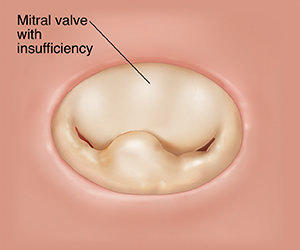
Mitral insufficiency means your mitral valve has problems closing. This lets blood leak back through the valve.
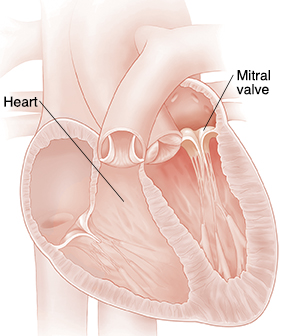
The heart has 4 valves. These valves help blood flow through the heart and out to the body by promoting forward flow and preventing back flow. The mitral valve lies between the 2 chambers of the heart on the left side. These 2 chambers are the left atrium and left ventricle. When the valve is open, it allows blood to flow from your lungs and left atrium to your left ventricle. When the left ventricle contracts to pump blood into your body, the mitral valve closes to prevent blood from leaking backward.
With mitral insufficiency, a small amount of leaking blood rarely leads to problems. But if the leaking is severe, it can cause damage to and enlargement of the heart. That's because the leaking of blood means the blood has to be pumped twice.
Possible causes of mitral insufficiency
Causes may include:
-
Heart damage from rheumatic fever or other infections or diseases
-
Aging
-
Mitral valve prolapse
-
Damage after a heart attack
Treating mitral insufficiency
Medicines may be prescribed. These help the heart work better. In severe cases, heart valve surgery may be needed to repair or replace the valve.


Related Articles
Brugada Syndrome
Brugada syndrome is a genetic disorder that causes an irregular heartbeat. This rare, but life- threatening condition is more common in people of Asian descent.
Unstable Angina
There are 2 types of angina, stable and unstable. Stable angina occurs at certain times and can often be managed. Unstable angina occurs at uncertain times. It may not get better with the usual forms of treatment for angina. It is a warning that a heart attack (acute myocardial infarction) is possible in the near future.
Understanding Venous Thromboembolism
Venous thromboembolism is when a blood clot forms in a vein. The term refers to two linked conditions: deep vein thrombosis (DVT) and pulmonary embolism.
Take Action to Beat Heart Disease
Even if you already have atherosclerosis or have had a heart attack, there's a lot you can do to prevent future heart problems.