You may have had chest pain (angina), dizziness, or other symptoms of heart trouble. To help diagnose your problem, your health care provider may advise a cardiac catheterization. This is a procedure that looks for a blockage or narrow area in the arteries around the heart. These can cause chest pain or a heart attack if not treated. It can also be used to evaluate other problems with your heart.
This common procedure may also be used to treat a heart problem. It may be done as a planned procedure if you've had chest pain in the past. Or it may be done right away to treat a suspected heart attack.
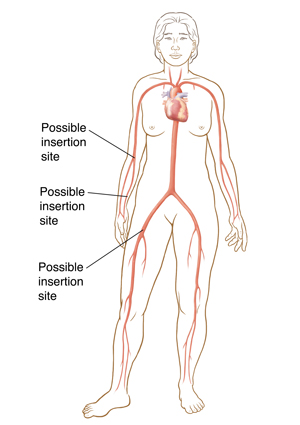
Before the procedure
-
Tell your health care team about all prescription medicines, over-the-counter medicines, vitamins, and supplements you take and about any allergies you have.
-
Follow any directions you're given for not eating or drinking before the procedure.
During the procedure
-
Hair may be trimmed where the catheter will be inserted. This may be in your leg (groin), wrist, or arm.
-
You may be given medicine to relax before the procedure.
-
You'll be given a local anesthetic to prevent pain at the insertion site.
-
A health care provider inserts a tube (sheath) into a blood vessel in your groin or arm.
-
Through the sheath, a long, thin tube called a catheter is placed inside the artery. The catheter is then guided toward your heart under X-ray guidance.
-
The catheter can then be used to measure pressures in the heart. It can take blood samples if needed. It can also be used to inject contrast liquid into the heart arteries to look for blockages. This is called angiography.
After the procedure
-
Your health care providers will tell you how long to lie down and keep the insertion site still.
-
If the insertion site was in your groin, you may need to lie down with your leg still for up to
6 or more hours. A stitch (suture) or closure device such as a collagen plug may be used on the artery site to close the site. If so, you may be able to move sooner. This depends on any bleeding that occurs. -
If your arm was used, you may need to wear a special type of immobilizing device and pressure bandage for a few hours after the procedure.
-
A nurse will check the insertion site and your blood pressure.
-
You may be asked to drink fluid. This is to help flush the contrast liquid out of your system.
-
Have someone drive you home from the hospital.
-
It’s normal to find a small bruise or lump at the insertion site. This should go away in a few weeks.
When to call your doctor
Contact your health care provider or seek medical care right away if you:
-
Have pain, swelling, redness, warmth, bleeding, or fluid leaking at the insertion site.
-
Are unable to pee.
-
Have blood in your urine, black or sticky stools, or any other kind of bleeding.
-
Have a fever of
100.4 °F (38.0 °C) or higher, or as advised by your provider.
Call 911
Call 911 if:
-
You have chest pain or pressure, nausea or vomiting, heavy sweating, dizziness, or fainting.
-
You are short of breath or have trouble breathing.
-
You have severe pain, coldness, or a bluish color in the leg or arm where the catheter was inserted.
-
You have sudden numbness or weakness in your arms, legs, or face, or you have trouble speaking.
-
The puncture site swells up very fast.
-
Bleeding from the puncture site doesn't slow down when you press on it firmly.


Related Articles
Coronary Atherectomy
Atherectomy is a procedure that relieves symptoms of coronary artery disease by improving blood flow to your heart.
Understanding Advanced Heart Failure and Left Ventricular Assist Devices
When you have heart failure, your heart can no longer pump the amount of blood your body needs to work correctly. A left ventricular assist device (LVAD) can help your heart pump blood.
Having Endovascular Repair of an Abdominal Aortic Aneurysm (AAA)
Endovascular repair is a type of treatment for an abdominal aortic aneurysm (AAA). An AAA is a bulge in the wall of the large artery below your heart.
Robotic-Assisted Patent Foramen Ovale Repair
A patent foramen ovale (PFO) is a small hole between the two upper chambers of the heart, the right and the left atrium. A robotic-assisted patent foramen repair is a type of surgery to fix this hole in the heart.