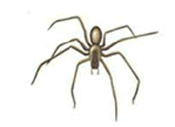
Brown recluse spiders are most often found in the South, West, and Midwest. They may be light or dark brown. They are ¼ inch to ¾ inch long, and have long, thin, legs. Some have a fiddle-shaped mark on their back. They prefer dark places and often live indoors in cupboards, basements, or attics. They also live outdoors under rocks or trash cans. These spiders only bite when disturbed.
When a brown recluse bites, a small red mark may form at the site. Then small blisters may appear. Within 2 to 8 hours, the area may become painful, swollen, and itchy. The child may develop a fever and be restless. Other possible symptoms include upset stomach (nausea), vomiting, and muscle pain. In most cases, the bite site heals on its own within a week. But in some cases, the skin at the bite site may break down and form an open wound (ulcer). An ulcer can take from a week to a few months to heal. In rare cases, a brown recluse bite may lead to more serious problems. These can include muscle damage, kidney failure, problems with blood clotting, and coma.
The doctor will clean the bite site and give medicines to relieve pain, if needed. Antibiotics may also be given to treat infection. A tetanus shot may be given. If an ulcer forms, skin grafting may be done later to repair severe damage to the skin. But most bites heal without scarring.
Home care
Medicines may be prescribed to relieve pain or treat infection. Follow directions for giving these medicines to your child.
General care
-
Let your child rest as needed.
-
Care for the bite site as directed by your child’s doctor.
-
To ease pain and swelling, apply cold packs to the bite site as directed. Use a cool wet washcloth or an ice pack. To make an ice pack, put ice cubes in a plastic bag that seals at the top. Then wrap the bag in a thin towel. Don’t put ice directly on the skin.
-
If your child was bitten in the arm or leg, it may help to keep the body part raised (elevated) to reduce swelling.
-
Check the bite site for any unusual changes or signs of infection (see below).
Prevention
-
Warn your child to stay away from woodpiles and other areas that attract spiders.
-
Catch spiders indoors by placing sticky tape on the floor.
-
Move your child’s bed away from the wall.
-
Teach your child to shake out clothes or blankets that have fallen onto the floor before using them.
-
Teach your child to shake out shoes before putting them on.
Follow-up care
Follow up with your child’s doctor, or as advised.
Poison Control
Call the Poison Help Line at 1-800-222-1222 if you have any immediate concerns. Or use webPOISONCONTROL® to get help online.
When to get medical care
Contact your child’s doctor right away if:
-
Your child has a fever of 100.4°F (38°C) or higher, or as advised by the doctor.
-
Your child's pain gets worse and is not relieved with medicine.
-
Your child has signs of infection at the bite site, such as more redness or streaking, swelling, or bad-smelling drainage.
-
The bite site becomes black or blue.
-
The bite site won’t heal or grows larger.
Featured in

Related Articles
Broken Thumb (Child)
Your child has a fracture (broken bone) in the thumb. A broken thumb will likely be painful, swollen, and bruised. Here's how to care for your child at home.
Colles Wrist Fracture, Reduction (Child)
The radius is the long bone that connects the thumb to the elbow. If the radius breaks near the wrist, it is called a Colles fracture. This kind of fracture is common in children. Colles fractures often occur when a child puts a hand forward trying to break a fall. It may also happen during sports.
Understanding Skull Fracture (Child)
A skull fracture is a type of head injury. The most common causes in children include falls, sports, and motor vehicle accidents.
Broken Collarbone (Child)
Your child has a broken collarbone (fractured clavicle). The collarbone connects the breastbone to the shoulder. This injury may cause pain, swelling, bruising, and a bump (deformity) around the break. A more serious collarbone break may harm nerves and blood vessels in the area, as well as the lungs.