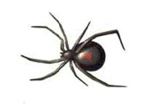
Black widow spiders are black and shiny. They are about a half-inch to 1 inch long. Only female black widows are dangerous. They have a red or orange marking on their bodies. Black widow spiders are found throughout the U.S. But they are most common in the southern and western states. They live in places such as woodpiles, porch furniture, and fences.
Black widow spider bites are rarely life-threatening. But they can be very dangerous to a small child. Common symptoms include:
-
Pain, swelling, numbness, and redness at the bite site.
-
Muscle pain.
-
Cramping.
-
Rigidity in the chest, belly (abdomen), and back.
-
Tremors (shaking).
-
Sweating.
-
Fast breathing.
-
Weakness.
-
Headaches.
-
An upset stomach (nausea) and vomiting.
-
A fast heart rate (in severe cases).
-
High blood pressure (in severe cases).
Symptoms most often appear within 30 minutes to 2 hours of the bite. They may last for 24 to 72 hours.
Antiseptic may be applied to the bite site. Cold packs may ease pain and swelling. Medicine may be given to relieve pain and muscle spasms. A tetanus shot may also be needed. For severe cases, your child may need to stay in the hospital. Antivenom may also be given. This treatment carries risk of allergic reaction. A delayed reaction to the antivenom called serum sickness can also occur 1 to 2 weeks later. This may cause symptoms, such as rash, fever, and joint pain.
Home care
An antiseptic may be prescribed to put on the bite. Be sure to use it as directed by your child's doctor.
General care
-
Care for the bite site as directed.
-
Let your child rest as needed.
-
Apply cold packs to the bite site to ease pain and raise (elevate) the part of the body that was bitten. Use a cool wet washcloth or crushed ice wrapped in a thin towel. Don't put ice directly on the skin.
-
Watch your child for any signs of allergic reaction or serum sickness if antivenom was given (see below).
-
Check the bite site daily for signs of infection (see below).
Prevention
-
Caution your child to stay away from woodpiles and other areas that attract spiders.
-
Hose down outdoor furniture often.
-
Catch spiders indoors by placing sticky tape on the floor.
-
Teach your child to shake out shoes and clothes before putting them on in case a spider is hiding in them.
-
Don’t keep anything under your bed.
Follow-up care
Follow up with your child’s doctor, or as advised.
Call the Poison Help Line at 1-800-222-1222 if you have any immediate concerns. Or use webPOISONCONTROL® to get help online.
When to get medical care
Contact your child’s doctor right away if:
-
Your child has a fever of 100.4°F (38°C) or higher, or as advised by the doctor.
-
Your child has belly pain.
-
Your child has chest tightness or trouble breathing.
-
Your child has muscle pain, cramping, and rigidity.
-
Your child has nausea and vomiting.
-
Your child has signs of allergic reaction to antivenom, such as skin itching, redness, swelling of face or mouth, or problems breathing.
-
Your child has signs of serum sickness, such as rash, fever or joint pain starting 1 to 2 weeks after treatment.
-
Your child has signs of infection at the bite site, such as increased redness or streaking, swelling, pain, or bad-smelling drainage.
-
The bite site becomes black or blue.
-
The bite site won’t heal or gets larger.
Featured in

Related Articles
Stitches or Staple Removal (Child)
Your child had a wound that was closed with stitches or staples. The wound has healed well enough that the stitches or staples can be removed. At this time there is no sign of an infection. Here's how to care for your child at home.
First Aid: Rescue Breathing
Rescue breathing is needed if a person collapses and stops breathing. In CPR, rescue breathing may also follow chest compressions if a person's heart is not beating. Know the steps.
Alcohol Ingestion (Child)
It's common for children to swallow alcohol by accident. Even a small amount of alcohol can cause alcohol poisoning in children. This can result in serious illness and sometimes death. Here's what you need to know to help your child.
Broken Thumb (Child)
Your child has a fracture (broken bone) in the thumb. A broken thumb will likely be painful, swollen, and bruised. Here's how to care for your child at home.