Balance is a group effort of your eyes, inner ear, joints, and muscles. They each send signals to the brain about body position and head movement. The brain uses this information to balance the body. When you have an inner ear problem, the brain may get conflicting signals. This can cause symptoms, such as the feeling of spinning (vertigo).
The inner ear sends signals
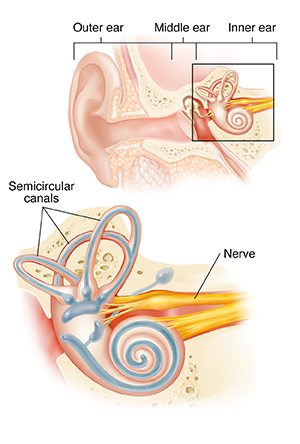
Inside the inner ear are three semicircular canals. Each canal contains tiny hairs, crystals, and fluid. These structures help the canals sense up-and-down, forward-and-backward, and side-to-side motion. Nerves carry the signals from the canals to the brain.
The brain interprets signals
Signals from all over your body travel to the brain. Once the signals arrive, the brain decides what they mean. Sometimes signals conflict. Have you ever sat on a stopped train and watched a moving train go by? When that happens, your eyes signal that you're moving. But your inner ear and body signal that you're still. The brain weighs conflicting data, such as this, and decides what's true. The result is balance.

Related Articles
Understanding Nasal Polyps
Nasal polyps are abnormal, soft growths in the nose or sinuses. Read on to learn more.
Salivary Gland Stones
Salivary gland stones can form as a result of poor salivary flow. Learn how to care for this condition at home.
Vertigo (Unknown Cause)
Problems with the inner ear can cause a false feeling of motion called vertigo. Learn about the possible causes, self-care, and when to get medical help.
Eardrum Rupture (Perforation)
An injury or infection can cause your eardrum to tear (rupture). This creates a hole (perforation) that may affect your hearing.