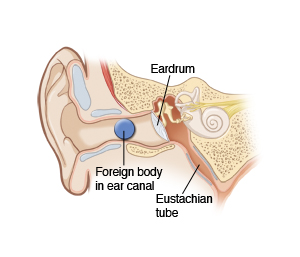
You or your child has an object in the ear canal. It may have been removed today by the healthcare team. A foreign body in the ear can lead to irritation. Sometimes this can cause infection in the ear canal. If the healthcare team was not able to remove the object today, you may be referred to an ear, nose, and throat specialist (ENT, or otolaryngologist) for follow-up care.
Home care
-
If prescription ear drops have been given, use these as directed. Don't get water in your ear for the next 5 days. (Don't go swimming for 5 days.)
-
Use over-the-counter pain medicine as directed. You may use acetaminophen, naproxen, or ibuprofen to control pain, unless another pain medicine was prescribed. Talk with your healthcare provider before taking these medicines if you have chronic liver or kidney disease, or if you have ever had a stomach ulcer or digestive bleeding.
Follow-up care
Follow up with your healthcare provider as advised.
When to seek medical advice
Call your healthcare provider or seek medical care right away if any of these occur:
-
Ear pain, itching, or discharge
-
Redness or swelling of the outer ear
-
Blood or fluid draining from the ear
-
Persistent hearing loss
-
Fever of 100.4°F (38°C) or higher, or as directed by your healthcare provider

Related Articles
Salivary Gland Stones
Salivary gland stones can form as a result of poor salivary flow. Learn how to care for this condition at home.
Peritonsillar Abscess
A peritonsillar abscess is a collection of pus that forms near the tonsils. Read on to learn about symptoms, diagnosis, and treatment.
Candida Infection: Thrush
Thrush is a type of fungal infection in the mouth and throat. Thrush does not usually affect healthy adults. It is more common in people with a weakened immune system. It is also more likely if you take antibiotics. Thrush is normally not contagious.
Peritonsillar Abscess
An abscess around the tonsils can cause severe sore throat, pain with swallowing, fever, drooling, and trouble opening the mouth.